
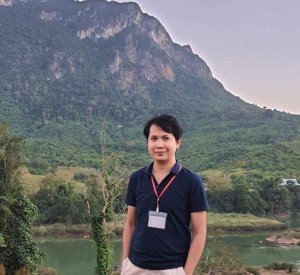
This month, we met with Dr. Phetsavanh Chanthavilay, a researcher and health economist at the Saw Swee Hock School of Public Health at the National University of Singapore. He’s currently studying the economic impact of rotavirus vaccination in Lao PDR.
How did you find your start in immunization economics? I started in health economics when I did my PhD thesis; I had never heard of health economics before, but I started working on it when I did my thesis which was on economic impact of HPV vaccination in Lao PDR. I did this about eight or nine years ago; I started in 2012 and finished in 2015, before HPV was introduced by the EPI.
Are you interested in a particular subject in the field? Before I was quite interested in building models, as when I conducted my thesis, it was more about mathematical modelling, not traditional health economics. So, I quite enjoy working on modelling work. Now, I’m more interested in improving immunization coverage in Lao PDR, as a major problem in Lao PDR is vaccination coverage is quite low, so I want to know how we can improve immunization coverage in Lao PDR with cost-effectiveness studies.
Is there a method or tool you’d like to explore more? I’m quite satisfied with my health economic background, but I want to focus on a multi-disciplinary approach, particularly combining epidemiological studies and intervention studies and then building the model to predict the cost-effectiveness outcome for policymaking decisions. Actually, I found it’s very difficult to conduct economic modelling in Lao PDR, because most data in Lao PDR are not available. We have to use estimations from literature reviews; for example with rotavirus infection, we have issues with local data on incidence. I’m not just interested in building economic models, I’m interested in going to the field, collecting data, and conducting interventions, so that it’ll be better for Lao PDR. We have very few epidemiologists.
Do you have any advice for aspiring health economists? My advice is probably different for low-income countries versus high-income countries. I’m currently training junior researchers to become health economists; they have difficulties in becoming health economists, because it’s quite a new subject for the country of Lao PDR. As junior researchers we have more knowledge of epidemiology but not in terms of health economics. My suggestion is being patient and try to present your work. When conduct modelling, it will take time in front of the computer. Consider how it will be used when disseminating and transferring evidence to policymakers. Researchers will find that their findings are useful and will help so many people! This is particularly important, as in Lao PDR we have difficulties with budget allocation because there have been many economic crises, so this is important for the country (to have more evidence). So, it’s important we motivate researchers to do this work.
What are you looking forward to at the moment? I’m looking forward to growing the NUS Lao Unit. I want the unit to be recognized by the Ministry of Health, so we can contribute to provide more evidence and applying for more funding opportunities to have more people involved in the team so the team can grow.
How do you like to spend your time outside of work? I enjoy reading books for self-development, and I like watching volleyball games and watching any series on Netflix. A recent book, one I liked a lot is Real Happiness: The Power of Meditation by Sharon Salzberg; I have recommended many people to read it. It helps a lot; I really like this book.
Where are you based, and what would you recommend to a visitor? In Lao PDR, there are two main cities to visit: the capital which is Vientiane and next city is Luang Prabang, which is a world heritage site. It’s very popular. I would suggest people visit here and discover the culture as well and enjoy the atmosphere in Luang Prabang. For Pi Mai (Lao New Year) this week, I will stay and spend time with my family.
Tea or coffee? Tea! I like tea, mostly green tea, because there are antioxidants in it that can help my health, and I also like the smell of green tea.
Are you interested in being featured in a future newsletter? Or would like to nominate another member? Please email immunizationeconomics@thinkwell.global with your suggestion and a brief description of your or their work. We are specifically interested in spotlighting the work and profiles of country researchers working on immunization economics.