
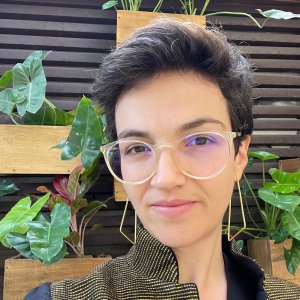
In August, we met with Noemi Schramm Ndao, a health financing consultant who works to improve public financial management for vaccine financing in West and Central Africa and the winner of the poster contest at our IHEA pre-congress session. You can learn more about her career and view her poster here.
Did you have a favorite session at IHEA, and what were some key takeaways for you?
Several! I really liked the session on traditional vaccines and subnational expenditures which is related to my work; it’s still a newer area for me, so that was a good learning opportunity. There was also a good session from Nigeria on health technology assessment (HTA) of the COVID-19 vaccine strategy.
Given that it was my first IHEA Congress, it was really nice to see how many tools there are at our disposal, and it was interesting to see how many people work on these kinds of topics and exchange with them.
Your pre-congress poster found that the Government of Sierra Leone uses public financial management (PFM) processes to ration cash by lengthening and therefore slowing down the payment process. How did the Government of Sierra Leone respond to this?
On the EPI program level, they had never seen each step in financing mapped out, so it was a learning process. They realized, for example, why things sometimes take so long, and it helped them to understand where they need to follow up and push things along. Since my study, three steps have been cut from the financing process. This doesn’t sound like much as it’s still a 24-step process, but that already helps. Something else which could be done is digitalizing the PFM process to improve insight into the process, speed it up, and reduce manual errors.
“Since my study, three steps have been cut from the financing process. This doesn’t sound like much as it’s still a 24-step process, but that already helps.”
How much time does making your work accessible to people like policymakers take up in the lifetime of the project?
Honestly a lot, and I think that’s a key part to making it successful afterwards. You must reduce the findings to the basics. You don’t even have to look at the details to see that it’s a long and complicated process, and my government counterpart was mainly interested in distillations of the work rather than detailed write ups.
Participants that voted for your poster highlighted the importance of research on PFM in immunization financing, and that more work around this is needed. Is there anything you’ve worked on that you’d like to dive into a little deeper?
Decentralization of spending power; some countries have moved towards this, and it comes with limitations, but I think it really helps especially if you don’t have too many institutions involved. And also improving budget credibility, when the budget is done based on actual resources available, you don’t have to advocate for certain payments to be prioritized and moved along, it gets disbursed because the money is planned for and there. And, finally: how are decisions made (and at what level) about which payments to prioritize and which not?
You’ve previously been seconded in the government of Sierra Leone. What do you think of secondment as a means of providing technical assistance, compared with your current role as more of an ‘external’ technical advisor?
I personally prefer it, the impact I can have is very different. Before I was working with a more implementation-focused mind, and now my approach is more research-focused. It was only when I moved out of government that I actually started writing things up and publishing more. For the entire area of PFM, we need to have good relationships, because the political economy dynamics are very important, and being seconded is the best way to understand those properly.
If you could go back in time and talk to yourself when you were just beginning your career, what advice would you give?
Always expect the unexpected, definitely when working with government. And that every experience, good and bad, is a lesson learned. Also be aware of your own privilege and how it affects your work and how you perceive things.
What do you like about your work the most?
I like the mix of analytical work and then translating that into policy briefs and the interaction with government. I always say I am a health economist but on the margins of political science.
How do you enjoy your free time outside of work?
I do a lot of group exercise classes, at least four a week. I also have two little girls, so they keep me busy.
What would you recommend to visitors about Dakar?
There is a series of concept stores that have popped up in many African capitals showcasing the best of design and fashion and art, you can do tours of these. We love to visit the beaches near Dakar and you can get some of the best seafood in the city.
Are you interested in being featured in a future newsletter? Or would like to nominate another member? Please email immunizationeconomics@thinkwell.global with your suggestion and a brief description of your or their work. We are specifically interested in spotlighting the work and profiles of country researchers working on immunization economics.