
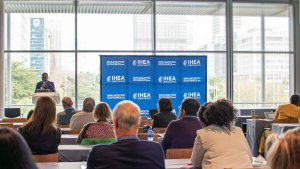
We recently met with Mr. Louis K. Tshituka, the Monitoring and Evaluation Team Leader for VillageReach in the Democratic Republic of Congo (DRC) and a PhD candidate  in health economics. His work focuses on monitoring an evaluation, quality, demand and use of evidence for decision-making, quality of services, capacity building, and research on health inequalities. At the Immunization Economics IHEA pre-congress, Louis presented on the cost of using drones to transport vaccines to hard-to-reach areas in DRC. You can read more about the Drones for Health project in DRC here (French) and here (English), as well as Louis’s reflections on lessons learned from the project.
All the sessions were great, but the session on the cost and sustainability of reaching zero-dose children was a particular favorite. I was interested in this session because it aligned with my research interests, as well as global immunization priorities. Once the cost of reaching zero-dose children is known, each strategy or solution must be accompanied by a plan for financial viability and sustainability.
“Once the cost of reaching zero-dose children is known, each strategy or solution must be accompanied by a plan for financial viability and sustainability.”
What was your key learning or takeaway from the IHEA pre-congress?
The importance of using data to inform strategic decision-making to support the sustainability and transition of solutions and projects. It is also great to have in-person events to facilitate networking.
How do you think you’ll incorporate the experience into your work?
At the event, I was able to meet a research team in-person with whom I have worked, and based on discussions at the pre-congress, we established a framework for future collaboration. The strategies shared by other countries for reaching zero-dose children will also inform our approach going forward, enabling us to modify our activities and programs.
Your pre-congress presentation was on the cost of using drones for transporting vaccines to hard-to-reach areas in DRC . What else do you think will be needed to reach zero-dose children in the country?
First, it is vital to understand the challenges faced by zero-dose children and their communities, and the context-specific interventions that can effectively reach them. We need to involve a wide range of stakeholders, including community leaders and form community discussion groups on immunization.
Second, it is also key that we have accurate data to regularly inform and adapt microplans. We need a tool for routine identification and tracking of zero-dose children, such as through a community-based information system. We need to integrate the identification of zero-dose and under-vaccinated children into the national health information system and immunization data collection system. Indicators relating to zero-dose and under-vaccinated children need to be included in EPI dashboards.
Could you tell us about the next project that you are working on?
As part of my thesis, I’m working on an analysis of the role of performance-based financial incentives as a means to address social inequalities in access to healthcare.
Using data from the World Bank’s evaluation of the impact of Performance-Based Financing (PBF) in the health sector in the DRC, we will conduct two studies. The first will analyze the effects of the PBF program on equity in health outcomes, with a focus on immunization coverage. The second will assess the affordability of healthcare. Our hypothesis is that PBF helps to protect patients against the catastrophic risk of health expenditure. These studies are thus at the heart of current global reflections in global health focused on how policies modify health inequalities.
You also recently attended a VERSE workshop on equity analysis; what did you learn that was relevant to your work?
The VERSE toolbox is an equity measurement tool to classify a country’s population according to the level of composite inequality, which is made up of known factors that equitably and unfairly influence access to and use of care. This tool will enable me to measure the coverage of PBF and the distribution of its effects on the population as part of my doctoral research.
What do you like most about your work?
I enjoy the cross-disciplinary nature of my work across different sectors, programs and projects. Using data to make decisions is the buzzword in the project management world these days. I’m very proud to help my organization use data to continually adapt our activities.
How do you like to spend time outside of work?
In my spare time, I like to read and go out with my family. We like to spend our free time around the majestic and mighty Congo River.
What is your recommendation for visitors to the DRC?
The DRC has a rich folklore and traditions, with a variety of tourist sites. When visiting the DRC, you’ll have the opportunity to discover its 9 national parks and the mythical bonobo, which lives only in this country.
Dance and music are also an integral part of tradition and daily life. You’ll have the chance to discover the Mutuashi, a dance and music genre that has its origins in the traditional music of the Luba tribe of Kasai.
M. Louis K. Tshituka est le chef de l’équipe de surveillance et d’évaluation de VillageReach en République démocratique du Congo (RDC) et candidat au doctorat en économie de la santé. Son travail se concentre sur le suivi et l’évaluation, la qualité, la demande et l’utilisation de données pour la prise de décision, la qualité des services, le renforcement des capacités et la recherche sur les inégalités en matière de santé. Lors du pré-congrès Immunization Economics de l’IHEA, Louis a présenté sur le coût de l’utilisation de drones pour transporter des vaccins dans les zones difficiles d’accès en RDC. Vous pouvez en savoir plus sur le projet Drones for Health en RDC ici (en français) et ici (en anglais), ainsi que sur les réflexions de Louis sur les leçons tirées du projet.
Quelle a été votre session préférée lors de notre pré-congrès de l’IHEA et pourquoi ?
Toutes les sessions étaient excellentes, mais la session sur le coût et la durabilité pour atteindre les enfants non vaccinés était particulièrement intéressante. Cette session a retenu mon attention car elle correspondait à mes domaines de recherche, ainsi qu’aux priorités mondiales en matière de vaccination. Une fois que le coût pour atteindre les enfants non vaccinés est connu, chaque stratégie ou solution doit être accompagnée d’un plan de viabilité financière et de durabilité.
Quelle a été votre principale leçon ou conclusion tirée du pré-congrès de l’IHEA ?
L’importance de l’utilisation des données pour éclairer la prise de décision stratégique afin de soutenir la durabilité et la transition des solutions et projets. Il est également bénéfique d’avoir des événements en personne pour faciliter le réseautage.
Comment pensez-vous intégrer cette expérience dans votre travail ?
Lors de l’événement, j’ai eu l’occasion de rencontrer en personne une équipe de recherche avec laquelle j’ai travaillé, et sur la base des discussions lors du pré-congrès, nous avons établi un cadre pour une collaboration future. Les stratégies partagées par d’autres pays pour atteindre les enfants non vaccinés informeront également notre approche à l’avenir, nous permettant de modifier nos activités et programmes.
Your pre-conference presentation focused on the cost of using drones to transport vaccines to hard-to-reach areas in the DRC. What else do you think it will take to reach unvaccinated children in the country?
First, it is essential to understand the challenges faced by unvaccinated children and their communities, as well as the context-specific interventions that can effectively reach them. We need to engage a wide range of stakeholders, including community leaders, and form community discussion groups on vaccination.
Secondly, it is also essential that we have accurate data to regularly inform and adapt microplans. We need a tool for systematic identification and monitoring of unvaccinated children, such as a community-based information system. We need to integrate the identification of unvaccinated and under-vaccinated children into the national health information system and immunization data collection system. Indicators relating to unvaccinated and under-vaccinated children should be included in EPI dashboards.
Could you tell us about the next project you are working on?
As part of my thesis, I am working on an analysis of the role of performance-based financial incentives as a means of combating social inequalities in access to health care. Using data from the World Bank’s evaluation of the impact of Performance-Based Financing (PBF) in the health sector in the DRC, we will carry out two studies. The first will analyze the effects of the PBF program on equity in health outcomes, with a focus on vaccination coverage. The second will assess the accessibility of health care. Our hypothesis is that PBF helps protect patients against the risk of catastrophic healthcare expenditures. These studies are therefore at the heart of current global thinking in global health focused on how policies modify health inequalities.
You also recently participated in a VERSE workshop on equity analysis; What have you learned that is relevant to your work?
The VERSE tool is an equity measurement toolkit for ranking a country’s population based on the level of composite inequality, composed of known factors that fairly and unfairly influence access to and use of care . This tool will allow me to measure the coverage of the PBF and the distribution of its effects on the population as part of my doctoral research.
What do you like most about your job?
I enjoy the interdisciplinary nature of my work across different sectors, programs and projects. Using data to make decisions is the name of the game in the world of project management these days. I take great pride in helping my organization use data to continually adapt our business.
How do you like to spend your time outside of work?
In my free time, I enjoy reading and spending time with my family. We love spending our free time around the majestic and powerful Congo River.
What is your recommendation for visitors to the DRC?
The DRC has rich folklore and traditions, with a variety of tourist sites. By visiting the DRC, you will have the opportunity to discover its 9 national parks and the mythical bonobo, which only lives in this country. Dance and music are also an integral part of tradition and daily life. You will have the chance to discover Mutuashi, a dance and a genre of music which has its origins in the traditional music of the Luba tribe of Kasai.
Are you interested in being featured in a future newsletter? Or would like to nominate another member? Please email immunizationeconomics@thinkwell.global with your suggestion and a brief description of your or their work. We are specifically interested in spotlighting the work and profiles of country researchers working on immunization economics.