
To close out the year, we got to know Dr. Richmond Owusu and his work at the University of Ghana School of Public Health and as a researcher for the Africa CDC, as well as how he enjoys spending his free time.
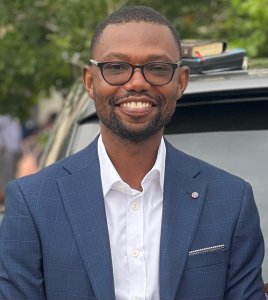 What are you currently working on? I play multiple roles at the University of Ghana. My main role is as a lecturer, so I teach graduate and undergraduate students and provide supervision for students’ thesis. I also conduct research and provide support to the Africa CDC. I’m a member of an Expert Working Group on priority-setting and resource optimization for emergency preparedness and response under the Health Economics Programme at Africa CDC. At the Ministry of Health, Ghana, I am a member of the health technology assessment technical working group (TWG).
Currently, the immunization-related research I’m doing is on the cost effectiveness of the COVID-19 vaccination in Ghana. Before, we had done costing for COVID-19 vaccines introduction and deployment using the CVIC tool and we rolled out the COVID-19 vaccination in Ghana in the year 2021. We now want to find out the value for money for introducing COVID-19 vaccinations, so we’re doing cost-effectiveness research for the vaccination program.
How did you find your start in the field of immunization economics? I was working closely with faculty when I was getting my PhD at the University of Ghana School of Public Health. Of course, some of the faculty knew that I was an aspiring economist. There were people who were interested in my career, particularly Professor Justice Nonvignon, the current head of the Africa CDC Health Economics Program. He approached me and asked me to join a study titled “Developing a framework for co-financing decisions: the Analysis of Interventions in Development Aid (AIDA) study.” He asked me to join as a form of training for me but also as a form of support to the study. The study was to explore and propose a principled framework for discussing donor co-financing decisions. In fact, with this study we explored the issue in the context of Gavi’s co-financing countries as they transition, and graduate to fully financing their vaccination programs. The focus was on Ghana and a set of comparison countries at different points on the transition pathway. Following this, after the COVID-19 pandemic has hit the world, we worked on another paper on fairer financing of vaccines in a world living with COVID-19.
My interest in immunization economics was building, so after that paper, Prof. Justice asked me to join a research team which was a collaboration between University of Ghana and PATH to conduct another study that was evaluating the cost and cost-effectiveness of Ghana’s switch from Rotarix to Rotavac vaccine. We assessed the cost of the switch and cost-effectiveness of this decision. At this point, I realized that immunization economics was one of the areas that I wanted to contribute to.
Are there specific topics you’re most interested in? I think generally I am interested in immunization financing and costs. Reflecting on what I’ve done so far, for example, I have been working closely with the Ministry of Health on the health technology assessment technical working group, as I mentioned before. We worked on the costing of COVID-19 vaccine introduction and deployment in Ghana using the CVIC tool which was developed by WHO and the World Bank. This work was key to resource mobilization domestically and internationally for Ghana.
One of the things that I’ve benefited from through the community of practice are the resources that you make available. I am familiar with UNIVAC and the CVIC tool, but I’ve also scanned the resource center and realized there are vaccine coverage and equity toolkits and also the immunization strategy costing application. These are definitely tools I’d like to learn more about. I’d also like to learn about fiscal health modelling for vaccination.
Which part of conducting research do you like best? Well, it’s interesting, I love to interact with the people on the ground. I love to have firsthand information, interacting with policymakers, interviewing frontline workers, and also traveling from one study site to another. These are things I enjoy. There is an intersection between collecting primary data and analysis of same. So, when you are directly involved in the data collection like field work, and also involved in the analysis, it is pleasurable. I enjoy doing that; it’s the best part, especially when you are able to transform the raw data into a final product that has meaning. I think it’s refreshing.
Have you read anything recently that you recommend to other community members? The most recent thing I’ve read was on “Understanding the Institutions of Domestic Health Financing Positions: Insights from immunization services in three low- and middle-income countries.” The countries were Kenya, Liberia, and Laos, and the goal was to try to position various stakeholders in a place where they will appreciate how countries can understand domestic health financing decisions, particularly in immunization financing as an example. The authors identified three key domains to which they mention attention should be paid, especially when developing donor transition strategies and strengthening the decision-making process. They mention that there are interchanges between domestic and international financing, national planning and budgeting, and central and subnational levels of government.
Immunization financing, even health financing more generally can consider these things, especially in the context of the COVID-19 pandemic which has restricted the financing in a lot of health areas. Also, in cases of countries who are transitioning from one Gavi co-financing level to another.
Do you have any tips for aspiring health economists? I would say, first, that health economics is fun! My first tip is that anybody aspiring to be a health economist should define their own space and specialization. The field of health economics is broad, so the ability to find your own specialty will contribute to being successful. Moreover, it is important to build networks. Connect with other people and then also develop your own quantitative analysis skills. This is critical to success.
Moreover, there is linkage between generating health economics evidence and health policy. The ability to work closely with policymakers is fundamental for every aspiring health economist, because when you generate evidence, the real impact is felt when they translate into policy and implement it. So, if you want to be a successful health economist, you should also build relationships and networks with policymakers so that the evidence generated can be translated into policies that create impact.
Finally, I’ll add that every aspiring health economist should have a mentor. It helps.
How do you like to spend your time outside of work? If it’s a long break from work, then I like to travel. If it’s a shorter length of time, then I will be doing church activities or be watching football.
Are you watching the World Cup? Definitely! The first team I’m rooting for is Morocco, and the reason is obvious! But I fancy France to win it again.
Where do you like to travel? Well, I’ve been to many different countries. I’ve been to Malaysia, Germany, the Netherlands, France, Belgium, Switzerland, Egypt, Ethiopia and Togo. I’ve been to quite a number of countries.
I just returned from Thailand about four weeks ago where I attended the International Conference on Family Planning. I enjoyed Pattaya City. It is a city that never sleeps. I also enjoyed Malaysia because there was a lot of food there. I try to take advantage of these conferences where I have a scientific paper to present or a conference to contribute to and take a break when I go. I mentioned that even for the research, I like the field work because sometimes it involves traveling and visiting different study sites. I really like traveling.
Where are you based and what would you recommend to a visitor? I am based in Accra. Anyone who wants to visit Ghana, I would encourage to come because Ghana is the land of great history and rich culture. Anybody who visits Ghana will enjoy our food; there’s a variety of food that everyone who visits loves so much. You may have heard the debate about the Ghana Jollof and Nigeria Jollof that goes on, but our food is some of the best in the world, so anyone who comes can enjoy.
Also, there are many, many tribes in Ghana, so we have a variety of culture and festivals. One of the biggest festivals in Ghana is the Akwasidae Festival and it is celebrated by the Asante Kingdom. Anyone who comes to Ghana should come and enjoy some of this.
What are you looking forward to at the moment? I look forward to really improving population health in low- and middle-income countries through 100% access to vaccinations and also through effective priority-setting and resource optimization. I think this is important because resources are always going to be scarce, so it is important that as a health economist I contribute to ensuring that scarce resources are used in the best possible way.
Are you interested in being featured in a future newsletter? Or would like to nominate another member? Please email immunizationeconomics@thinkwell.global with your suggestion and a brief description of your or their work. We are specifically interested in spotlighting the work and profiles of country researchers working on immunization economics.